California Ballot Measures 2026: What All 14 Propositions Do and How They Trade
California ballot measures 2026 add up to 14 statewide propositions on the November 3 ballot: Props 1 to 5 and 37 to 45. Some platforms may list contracts on ballot measures. Listings and prices change, so verify availability in the regulated US app and read the settlement rules before trading.


- Election date: Tuesday, November 3, 2026
- Number of statewide propositions: 14 (certified by the Secretary of State on June 25, 2026)
- Numbering: Props 1 to 5 and Props 37 to 45
- Who put them there: 5 legislative measures (Props 1, 2, 4, 5, 43) and 9 citizen initiatives
- Market availability: verify current listings in each regulated US app
Affiliate disclosure: We may earn a commission if you sign up through links on this page, at no extra cost to you. This doesn't influence our editorial content.
Key facts at a glance
- •Election date: Tuesday, November 3, 2026
- •Number of statewide propositions: 14 (certified by the Secretary of State on June 25, 2026)
- •Numbering: Props 1 to 5 and Props 37 to 45
- •Who put them there: 5 legislative measures (Props 1, 2, 4, 5, 43) and 9 citizen initiatives
- •Market availability: verify current listings in each regulated US app
- •Results certified by: December 11, 2026 (Secretary of State deadline)
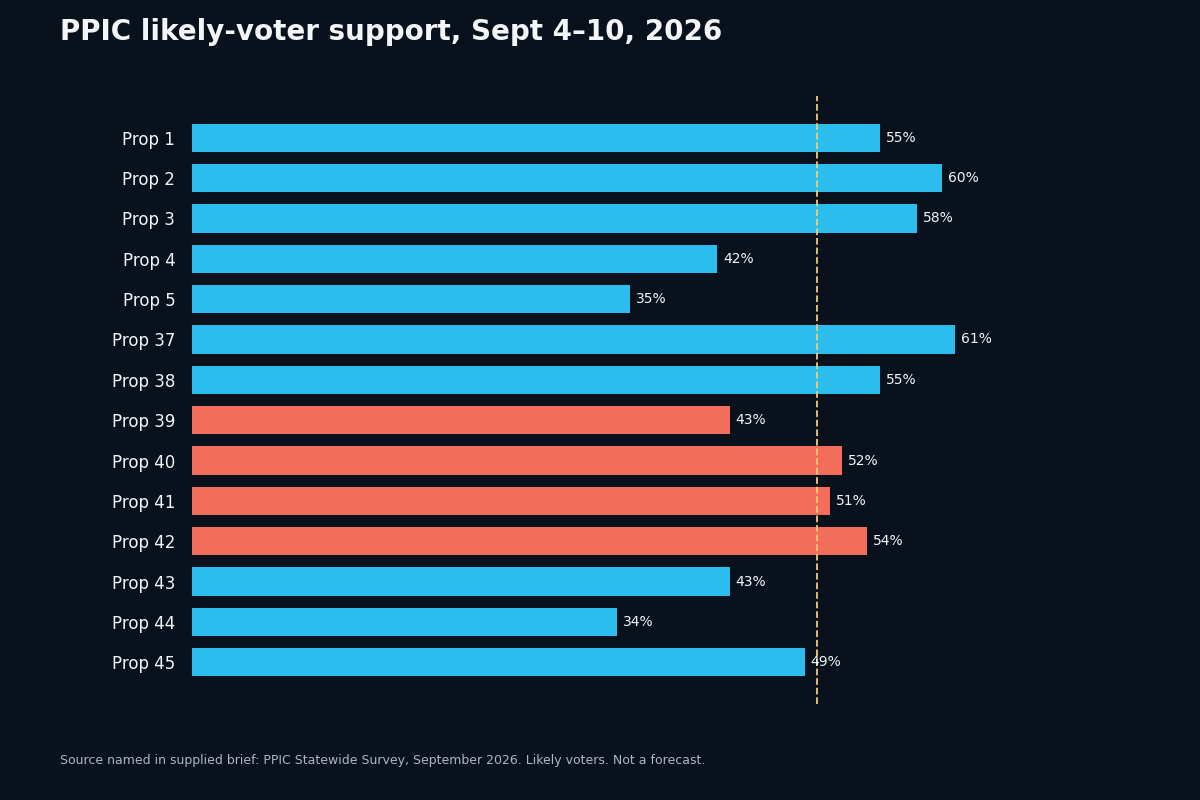
Prop 40, 41 and 42: the ballot's real three-way contest
Prop 40 would charge California billionaires a one-time tax equal to 5% of their net worth, with payments due in 2027. The LAO says 90% of the money would go to health care, with the rest to education, food assistance and administration. It estimates "tens of billions of dollars" in one-time revenue.
The catch is how California handles conflicting measures. The LAO says both Prop 41 and Prop 42 conflict with Prop 40. If Prop 40 passes but Prop 41 or Prop 42 passes with more yes votes, Prop 40 could be blocked from taking effect. As CalMatters put it on September 24, 2026: "If either 41 or 42 outpolls Prop. 40, the billionaire tax does not take effect."
What that means for a trader:
- •Read the contract's resolution rules first. A contract on whether Prop 40 "passes" and a contract on whether the tax "takes effect" can settle differently. Kalshi lists both kinds; its "take effect" market resolves in 2027.
- •Watch the three yes totals together. Prop 40 winning 52% means little if Prop 42 wins 55%.
- •Expect late movement. PPIC's polling director noted voters may not yet "realize they're direct countermeasures." Campaign spending in October is likely to change that.
Contract prices move continuously. Verify the current regulated US listing and read whether settlement depends on passage or the measure taking effect.
How to read a ballot-measure contract
- •Use the official title, not the ads. The ballot label voters see is written by the Attorney General, and it often reads very differently from campaign messaging. Compare the contract to the official title in the Voter Information Guide.
- •Check what "yes" settles on. Most contracts resolve on the certified Secretary of State result. California counts for weeks, and certification is due by December 11, 2026.
- •Mind the polling gap. Initiative support often falls as Election Day nears and "no" campaigns spend. A poll above 50% in September is not a lock.
- •Size to the market. Look at volume and the order book before placing a position. Our guide on how to read an order book walks through it.
- •Price is probability, not certainty. Always record the platform and timestamp when comparing a market price with polling.
Last reviewed by Catie Di Stefano on September 28, 2026. We re-verify market prices, polling, and citations on every update.
Frequently Asked Questions
More from the same hub
Pillar pages
Sources & references
- 1.Commodity Futures Trading Commission — Event Contracts — CFTC.gov
- 2.California Secretary of State — Elections — sos.ca.gov
- 3.Public Policy Institute of California — Statewide Survey — PPIC.org
- 4.UC Berkeley Institute of Governmental Studies Poll — IGS, UC Berkeley
- 5.Los Angeles Times — California politics coverage — Los Angeles Times
- 6.CalMatters — Nonpartisan California news — CalMatters
- 7.Polymarket and the rise of prediction markets — Associated Press
External links open in a new tab. We cite primary regulatory and major news sources where possible. Citations to trusted regulators (CFTC, SEC, IRS, NOAA, .gov, .edu) are dofollow; commercial outbound links are not endorsements.
Catie Di Stefano has spent 15 years in the regulated gambling industry, starting at Betsson Group in Malta and spending nearly five years at Gaming Innovation Group (GiG) before building an independent consultancy across European and US iGaming brands, including a licensed engagement with Hard Rock Hotel & Casino Atlantic City under a New Jersey DGE vendor license.
She's been interviewed by the California Business Journal on the rise of online gambling in the US, and spoke on a 2022 Next.io panel specifically about California's gaming market.