Real Money, Real Trades: How Our Prediction Market App Testing Works
The Venice Score is our documented review framework. It prioritizes withdrawal reliability, true trading costs, California market depth, regulatory footing, first-hour experience and honest bonus value.


- Real money: at least $250 of editorial capital per app, deposited from a California address with a California ID.
- Live trades: at least 25 trades on real contracts, spread across three or more categories (sports, politics, economics, crypto, weather, culture).
- Every rail: deposits and withdrawals tested on each supported method, including ACH, debit card, and crypto where offered.
- Support: each advertised support channel contacted at least twice, with response times logged.
- Regulatory check: CFTC designation, custody of customer funds and enforcement history reviewed alongside the hands-on test.
Affiliate disclosure: We may earn a commission if you sign up through links on this page, at no extra cost to you. This doesn't influence our editorial content.
Our Take
A fee table tells you what an app promises. A withdrawal tells you what it does. That is the whole reason we fund real accounts: the things that matter most to a trader, such as how long cash takes to clear, whether a bonus survives its fine print, and whether support answers when something breaks, only show up when real money is on the line. So cash-out reliability carries the most weight in our score, and an app that fails it is capped no matter how good its markets look.
The rules of our prediction market app testing
Every requirement below comes from our published methodology, as of September 26, 2026:
- •Real money: at least $250 of editorial capital per app, deposited from a California address with a California ID.
- •Live trades: at least 25 trades on real contracts, spread across three or more categories (sports, politics, economics, crypto, weather, culture).
- •Every rail: deposits and withdrawals tested on each supported method, including ACH, debit card, and crypto where offered.
- •Support: each advertised support channel contacted at least twice, with response times logged.
- •Regulatory check: CFTC designation, custody of customer funds and enforcement history reviewed alongside the hands-on test.
Each published review states which tests were completed and when. We do not present a planned test as completed evidence.
What goes into the Venice Score
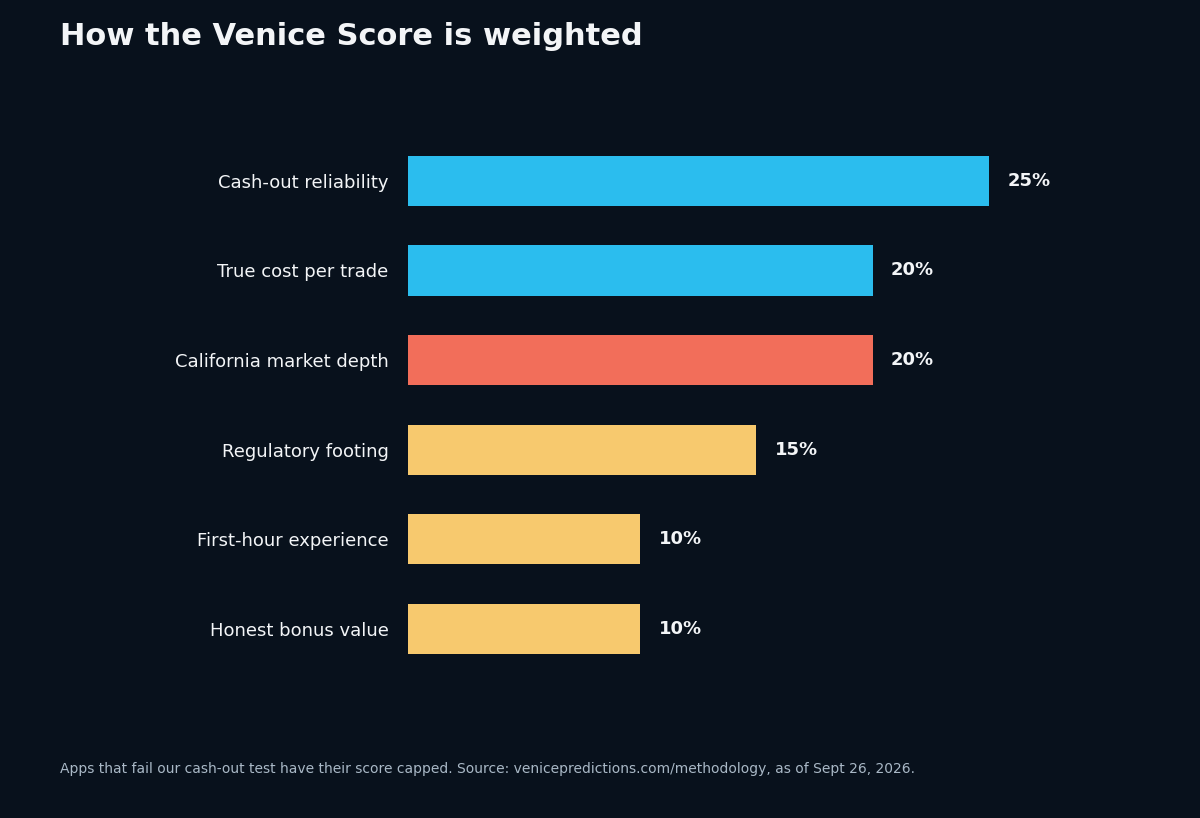
The score weights six categories:
- 1.Cash-out reliability, 25%: hours to cleared funds, fees, ID re-checks at withdrawal, support responsiveness.
- 2.True cost per trade, 20%: stated fees plus spreads, slippage on a $1,000 order, settlement and deposit costs.
- 3.California market depth, 20%: open interest in California markets such as the Dodgers, Lakers, Rams, 49ers and the 2026 governor's race.
- 4.Regulatory footing, 15%: CFTC status, custody of customer funds, enforcement disclosure.
- 5.First-hour experience, 10%: time from signup to first trade, identity-check friction from a California address, how clearly orders read.
- 6.Honest bonus value, 10%: what a promo is worth after rollover and withdrawal restrictions.
The rule that matters most: an app that fails the cash-out test has its score capped, whatever it earns elsewhere.
Where our facts come from
Numbers on this site are quoted, never estimated. We rank sources in three tiers:
- •Tier 1, primary: CFTC filings, court dockets and each operator's published terms.
- •Tier 2, major newsrooms: Reuters, Bloomberg, The Wall Street Journal, The New York Times and AP.
- •Tier 3, specialist trades: industry publications and academic research.
User counts, volumes and valuations only appear when a Tier 1 or Tier 2 source or the operator itself has published them. Confirmed errors are corrected within 48 hours, with a timestamped note at the top of the page.
How to read a Venice Score
- •Treat cash-out reliability as the floor. An app with deep markets but a slow or unreliable withdrawal will score lower here than its liquidity alone suggests.
- •Check the date. Reviews and our Top-Apps list are rechecked on at least a 30-day cycle and evergreen guides every quarter. A score is a dated snapshot, not a permanent verdict.
- •Look past the headline bonus. Honest bonus value measures what an offer is worth after its conditions, which is often less than the number in the ad.
- •Read the full review. The score summarizes; the Kalshi review, Polymarket review and ProphetX review show the detail behind it.
Last reviewed by Catie Di Stefano on September 29, 2026. We re-verify market prices, polling, and citations on every update.
Frequently Asked Questions
More from the same hub
Pillar pages
Sources & references
- 1.Commodity Futures Trading Commission — Event Contracts — CFTC.gov
- 2.CFTC Final Rule on Event Contracts — CFTC.gov
- 3.Kalshi wins court battle to offer election contracts — Reuters
- 4.National Council on Problem Gambling — 1-800-GAMBLER — NCPG
External links open in a new tab. We cite primary regulatory and major news sources where possible. Citations to trusted regulators (CFTC, SEC, IRS, NOAA, .gov, .edu) are dofollow; commercial outbound links are not endorsements.
Catie Di Stefano has spent 15 years in the regulated gambling industry, starting at Betsson Group in Malta and spending nearly five years at Gaming Innovation Group (GiG) before building an independent consultancy across European and US iGaming brands, including a licensed engagement with Hard Rock Hotel & Casino Atlantic City under a New Jersey DGE vendor license.
She's been interviewed by the California Business Journal on the rise of online gambling in the US, and spoke on a 2022 Next.io panel specifically about California's gaming market.