California Earthquake Prediction Markets: What You Can Trade and How They Settle
Earthquake event contracts use precise magnitude, location, deadline and data-source rules. Listings change, and earthquakes cannot be forecast day to day, so compare any current contract with USGS long-term base rates and read its settlement terms.


- Data source: the U.S. Geological Survey. Settlement uses USGS's final reviewed magnitude, not the first preliminary estimate.
- Magnitude type: moment magnitude (Mw) of 7.0 or greater.
- Location: the epicenter must be within California, including offshore areas inside the state's territorial boundaries.
- Timing: the quake must occur by December 31, 2026, 11:59:59 PM ET.
- Type of event: a mainshock, aftershock or foreshock all count if they meet the criteria.
Affiliate disclosure: We may earn a commission if you sign up through links on this page, at no extra cost to you. This doesn't influence our editorial content.
Our Take: Earthquake contracts put the resolution rules ahead of headlines because no one can reliably predict the next rupture. That makes the resolution rules, not the headlines, the thing to study. Read the magnitude threshold, the geographic boundary and the deadline before anything else, and compare the price with the USGS base rate. Treat these as a way to express a view on long-run risk, not as a fast-moving market like our wildfire season guide covers.
How California earthquake prediction markets settle
Every earthquake contract comes down to a few lines of rules. For the Polymarket contract, those rules say:
- •Data source: the U.S. Geological Survey. Settlement uses USGS's final reviewed magnitude, not the first preliminary estimate.
- •Magnitude type: moment magnitude (Mw) of 7.0 or greater.
- •Location: the epicenter must be within California, including offshore areas inside the state's territorial boundaries.
- •Timing: the quake must occur by December 31, 2026, 11:59:59 PM ET.
- •Type of event: a mainshock, aftershock or foreshock all count if they meet the criteria.
The location line matters more than it looks. Many strong California quakes start offshore near Cape Mendocino, where three tectonic plates meet. A quake felt across Humboldt County can still fall outside a contract's boundary if its epicenter lies too far out to sea. Preliminary magnitudes also get revised, sometimes by a tenth of a point or more, and a revision from 7.0 to 6.9 is the difference between Yes and No. Kalshi's rulebook sets its own source and boundary, so read it on the contract page before you take a position.
What the science says
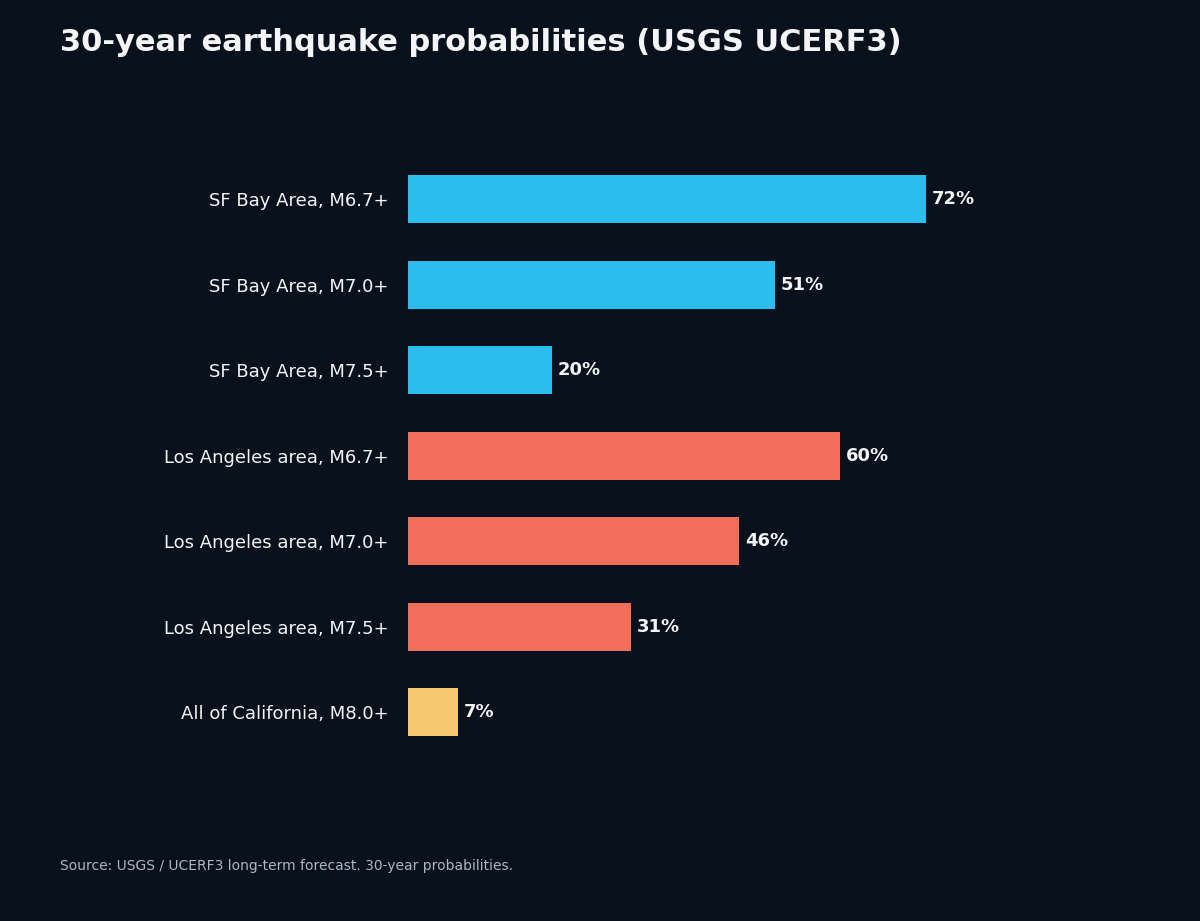
The U.S. Geological Survey cannot predict earthquakes, and it says so plainly. What it publishes are long-term probabilities from UCERF3, the Uniform California Earthquake Rupture Forecast. Its 30-year figures:
- •San Francisco Bay Area: 72% chance of a magnitude 6.7 or larger, 51% for 7.0 or larger, 20% for 7.5 or larger
- •Los Angeles area: 60% for 6.7 or larger, 46% for 7.0 or larger, 31% for 7.5 or larger
- •All of California: about 7% chance of a magnitude 8.0 or larger
Those are 30-year numbers. A contract that runs a few months covers only a small slice of that window, which is why short-dated prices should sit well below them. Low-probability contracts often trade above a strict base-rate estimate, because someone has to be willing to sell a cheap Yes, and small markets rarely have enough sellers. That is our reading of how these markets behave, not a USGS finding.
Why earthquake contracts behave differently from weather contracts
Our El Nino 2026 guide and wildfire coverage deal with risks that build over weeks, with forecasts that update daily. Earthquakes work differently:
- •No short-term forecast: there is no equivalent of a Red Flag Warning or a seasonal outlook for a fault line.
- •Flat, then sudden: prices tend to drift slowly for months, then reprice in minutes when a large quake happens anywhere near the threshold.
- •Aftershock windows: after a big quake, USGS publishes aftershock forecasts, and those are one of the few times short-term probabilities genuinely change.
- •Time decay: as the deadline approaches with no qualifying event, a Yes contract loses value steadily.
How to read an earthquake contract responsibly
- •Compare with the base rate. Before buying Yes, ask whether the price is higher than the USGS numbers suggest for that window.
- •Check liquidity. Look at volume and the bid/ask spread. A wide spread on a thin market can cost more than the edge you think you have.
- •Size positions small. These are low-probability, long-dated contracts. Most Yes positions expire worthless.
- •Do not trade on rumours. Viral "quake predictions" have no scientific basis. USGS is explicit that no one can predict the date, time and place of a major earthquake.
- •Mind the timing if a quake hits. Settlement waits for USGS's final reviewed magnitude, which can take time.
If you are new to event contracts, start with how to trade and our trading strategies guide. Terms like implied probability and resolution criteria are in the glossary.
Last reviewed by Catie Di Stefano on September 29, 2026. We re-verify market prices, polling, and citations on every update.
Frequently Asked Questions
More from the same hub
Pillar pages
Sources & references
- 1.Commodity Futures Trading Commission — Event Contracts — CFTC.gov
- 2.Kalshi wins court battle to offer election contracts — Reuters
- 3.Prediction markets coverage — Wall Street Journal
External links open in a new tab. We cite primary regulatory and major news sources where possible. Citations to trusted regulators (CFTC, SEC, IRS, NOAA, .gov, .edu) are dofollow; commercial outbound links are not endorsements.
Catie Di Stefano has spent 15 years in the regulated gambling industry, starting at Betsson Group in Malta and spending nearly five years at Gaming Innovation Group (GiG) before building an independent consultancy across European and US iGaming brands, including a licensed engagement with Hard Rock Hotel & Casino Atlantic City under a New Jersey DGE vendor license.
She's been interviewed by the California Business Journal on the rise of online gambling in the US, and spoke on a 2022 Next.io panel specifically about California's gaming market.